Learn how dishing presses shape metal plates into dished heads for pressure vessels and industrial applications.
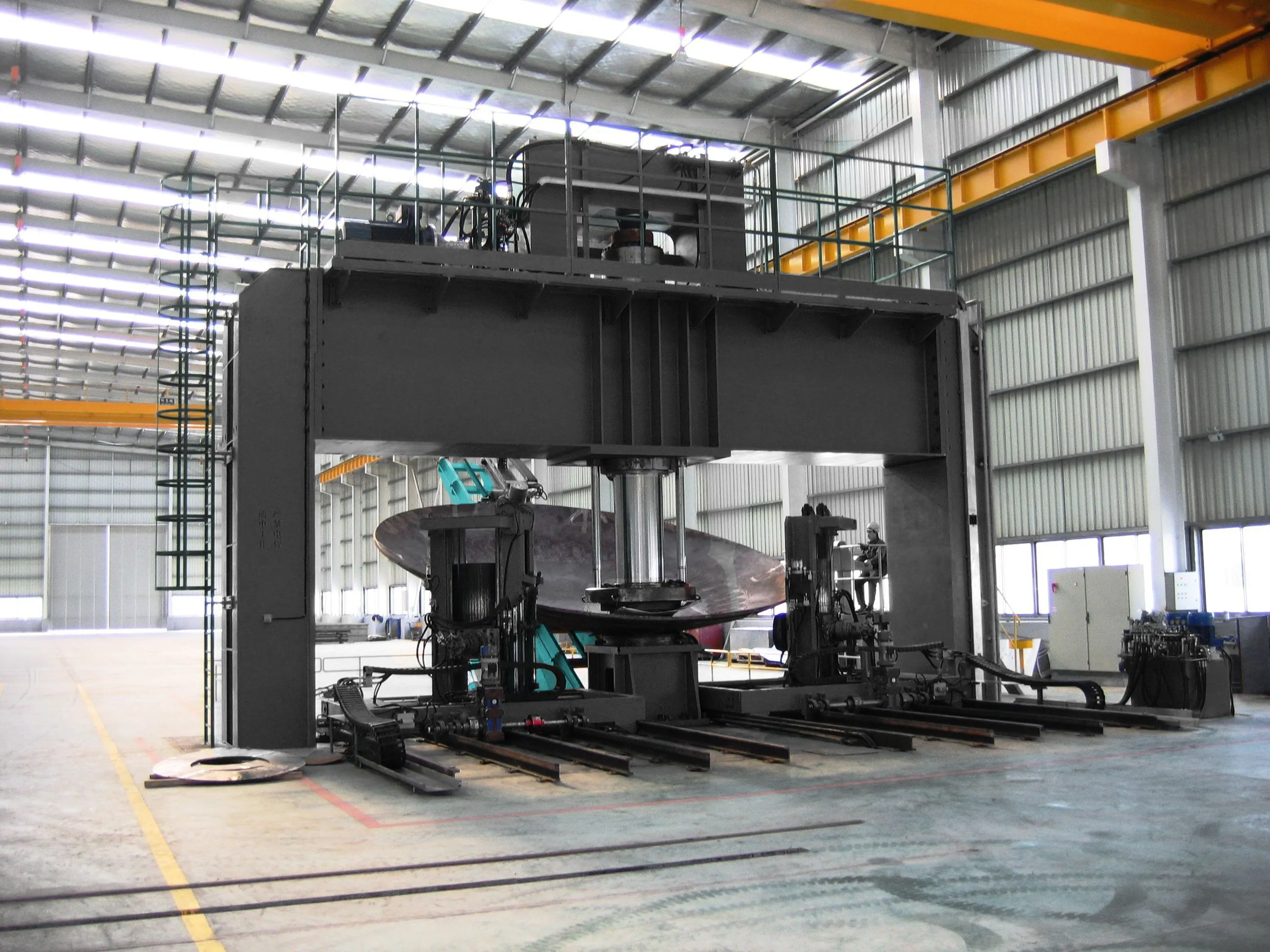
A dishing press is one of the most important machines used in the manufacturing of dished heads. By applying controlled forming forces to a flat metal plate, the press creates the primary curved geometry required for pressure-retaining components.
Modern dishing presses are designed to process a wide range of materials and thicknesses while maintaining high levels of accuracy and repeatability.
What Is a Dishing Press?
A dishing press is a hydraulic forming machine used to generate the main profile of a dished head. The process transforms a flat plate into a curved component suitable for subsequent manufacturing operations.
It represents a fundamental stage within the complete dishing and flanging process.
How Does a Dishing Press Work?
The press applies controlled force through dedicated tooling to progressively deform the material until the desired geometry is achieved.
The process is carefully monitored to ensure dimensional accuracy and material integrity.
Main Advantages of Dishing Presses
- High forming capacity.
- Excellent dimensional accuracy.
- Capability to process thick materials.
- Consistent production quality.
- Reduced manufacturing time.
- Improved productivity.
Industrial Applications
- Pressure vessels.
- Storage tanks.
- Heat exchangers.
- Energy industry equipment.
- Chemical processing plants.
- Oil and gas installations.
Dishing Presses and Modern Automation
Modern machines incorporate CNC controls, hydraulic systems and advanced process monitoring technologies.
This allows manufacturers to improve productivity while maintaining high quality standards.
Dishing Presses in Head Manufacturing
Dishing presses are frequently integrated with head forming machines and flanging equipment to create complete production systems.
Today they remain one of the most important technologies for producing reliable dished heads for industrial applications.